

 TBI Vienna
License: ViennaRNA is licensed under Custom (ViennaRNA Package License) and may require explicit attribution when utilized. Please refer to the license for full terms.
Proto is not affiliated with TBI Vienna. This toolkit is open source and builds on the implementation produced by this organization. Product names, logos, and trademarks are the property of their respective owners.
ViennaRNA/ViennaRNA
ViennaRNA Package 2.0
 evo-design/proto-tools/proto_tools/tools/structure_prediction/viennarna
Open Notebook
Open notebook


Background
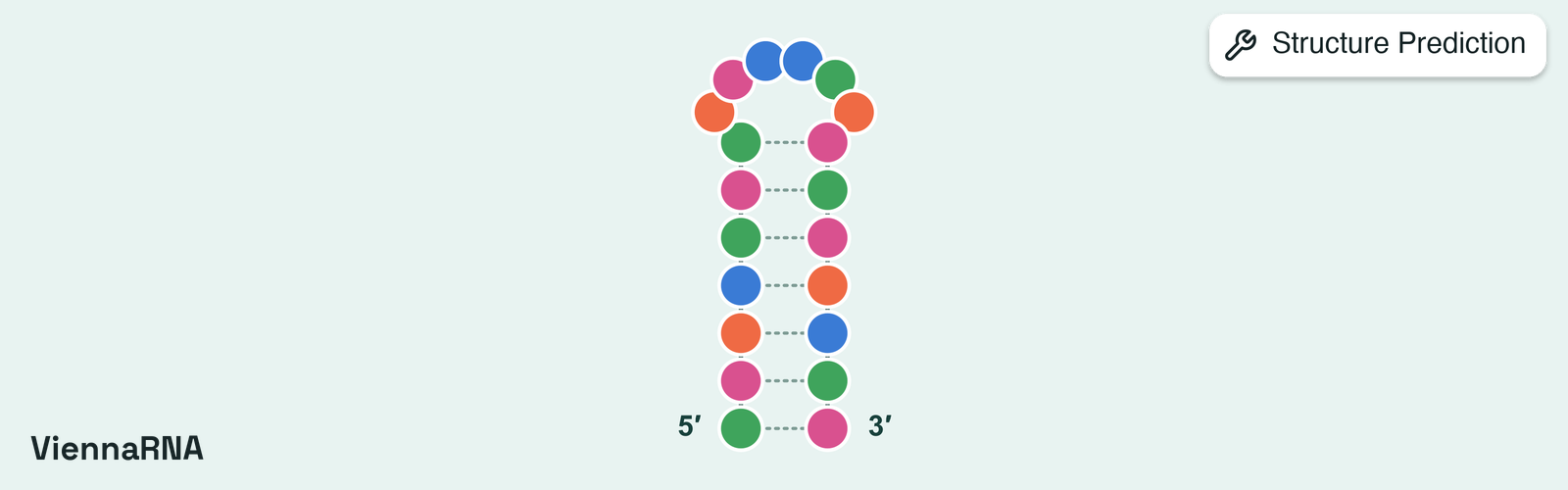
ViennaRNA (Lorenz et al., 2011) predicts the secondary structure of a nucleic-acid sequence: the set of intramolecular base pairs that form within a single strand. Secondary structure sits between sequence and three-dimensional shape and governs how many functional RNAs behave, so predicting it from sequence alone is a core step in RNA analysis and design. Internally, ViennaRNA folds each sequence with the minimum-free-energy dynamic program at the core of RNAfold (cubic in the sequence length) under a nearest-neighbor thermodynamic model. RNA sequences use the Turner 2004 parameters. Selecting the DNA option instead loads the Mathews 2004 DNA parameters. The predicted structure is returned in dot-bracket notation together with its minimum free energy in kcal/mol, where a more negative value indicates a more stable predicted fold. Because it is a thermodynamic rather than a learned method, it is deterministic, runs on CPU, and predicts secondary structure only, not three-dimensional coordinates. The reference implementation is the ViennaRNA Package, maintained by TBI Vienna at ViennaRNA/ViennaRNA.Learning Resources
- ViennaRNA Package documentation and tutorials (TBI Vienna) - the official documentation, worked tutorials, and the RNAfold web server for trying predictions interactively.
Tools
ViennaRNA Secondary Structure Prediction (viennarna-prediction)
Folds each input sequence to its minimum-free-energy secondary structure, returning the structure in dot-bracket notation and the minimum free energy in kcal/mol for every sequence.API Reference
Source
Input: ViennaRNAInput
Input: ViennaRNAInput
List[string]
required
RNA (A, U, G, C), DNA (A, T, G, C), or N sequences to fold (any case). T is converted to U before folding unless DNA parameters are used.
Source
Config: ViennaRNAConfig
Config: ViennaRNAConfig
number
default:"37.0"
Temperature in Celsius for energy calculations.
boolean
default:"False"
Use DNA energy parameters instead of RNA parameters.
boolean
default:"False"
Disallow lonely base pairs (helices of length 1).
enum
default:"2"
Dangling-end treatment (0=ignore, 1=minimal, 2=multibranch, 3=accurate).Available options:
0, 1, 2, 3boolean
default:"False"
Treat sequence as circular (plasmids, viroids, circRNAs).
integer
default:"-1"
Max base-pair span in nt; -1 = no limit, positive forbids long-range pairs.
integer
default:"0"
Verbosity level (0=quiet, 1=info, 2=debug, 3=raw subprocess stderr).
True is coerced to 1 and False to 0.string
default:"cpu"
Device to run the tool on.
integer
default:"3600"
Maximum execution time in seconds.
None waits indefinitely.integer
Random seed. When set, tools run reproducibly up to small GPU float noise (see
BaseToolOutput.approx_equal), and the seed participates in cache keys. When None, cacheable seed-sensitive tools skip cache until seeded. Source
Output: ViennaRNAOutput
Output: ViennaRNAOutput
List[ViennaRNAResult]
required
List of fold results, one per input sequence. Each result contains the sequence, predicted structure in dot-bracket notation, and the minimum free energy.
Applications
Use this to predict the base-pairing of mRNAs, non-coding RNAs, riboswitches, aptamers, or designed RNA constructs from sequence alone, for example to check whether a designed UTR or guide RNA folds as intended, or to rank candidate sequences by the stability of their predicted fold.Usage Tips
temperature(default37.0, degrees Celsius) sets the folding temperature. The energy model is temperature-dependent, so the predicted structure and free energy change with it. Keep the default for physiological predictions and change it to model other conditions.use_dna_params(defaultFalse) also changes how the input is read. WhenFalse, anyTin a sequence is converted toUand the sequence is folded as RNA with the Turner 2004 parameters. Set itTrueto fold the sequence as DNA with the Mathews 2004 DNA parameters and noT-to-Uconversion.- Set
circtoTruefor circular molecules. Plasmids, viroids, and circular RNAs fold differently from linear strands, and the default treats the sequence as linear. no_lonely_pairs(defaultFalse) forbids isolated base pairs. Enabling it removes length-one helices, which often yields more physically realistic structures.dangles(default2) sets dangling-end energy treatment. Choose0to ignore dangling ends,1for minimal,2for multibranch, or3for the most accurate model.max_bp_span(default-1, unlimited) caps the base-pair span. Set a positive value to forbid long-range pairs, which is useful for very long sequences or local-structure analysis.
Toolkit Notes
These apply to every ViennaRNA tool in this toolkit (viennarna-prediction).
- Runs on CPU. ViennaRNA is a fast C package and does not use a GPU. Folding is near-instant for typical sequences, and runtime grows as the cube of sequence length, so very long inputs are slower.
- Predicts secondary structure only. The output is a base-pairing pattern and a free energy, not three-dimensional atomic coordinates; use a tertiary-structure method when 3D is needed.
Infrastructure Guides
The following guides cover how to run tools efficiently and at scale.Tool Persistence
Keep a tool’s model warm across calls instead of reloading it every invocation.
Device Management
How GPUs are allocated to tools and how to target specific devices.
Parallel Execution
Fan a batch of inputs out across multiple GPUs.