

 IPD
IPDLicense: ProteinMPNN is open source and free for academic and commercial use under an MIT license. Please refer to the license for full terms.
Proto is not affiliated with Institute for Protein Design. This toolkit is open source and builds on the implementation produced by this organization. Product names, logos, and trademarks are the property of their respective owners.
dauparas/ProteinMPNN
Code for the ProteinMPNN paper
1.8k stars
Robust deep learning—based protein sequence design using ProteinMPNN
 evo-design/proto-tools/proto_tools/tools/inverse_folding/proteinmpnn
Open Notebook
Open notebook


Background
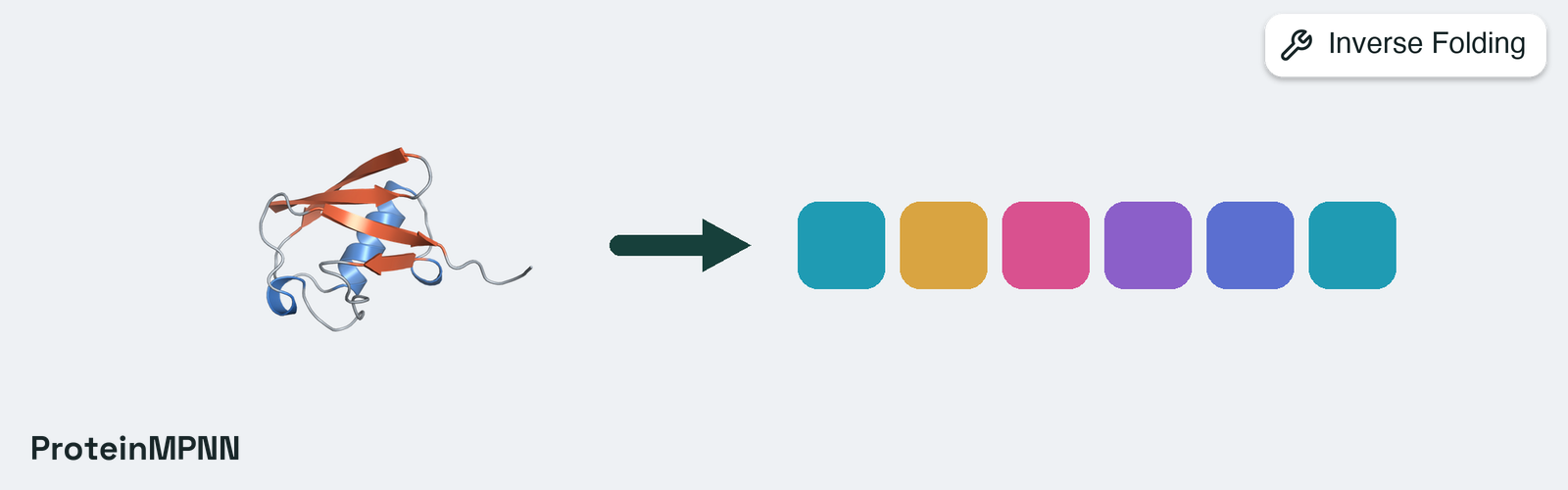
ProteinMPNN (Dauparas et al., 2022) solves the inverse-folding problem: given a fixed protein backbone (the 3D coordinates of its N, C-alpha, C, and O atoms), predict an amino-acid sequence that will fold into that structure. It is the inverse of structure prediction and a core step in protein design, where a backbone is proposed first and a sequence that encodes it is designed afterwards. Internally, ProteinMPNN encodes the backbone as a graph: each residue is a node connected to its 48 nearest neighbors in space, with edges featurized by inter-atomic distances between the backbone atoms (including a virtual C-beta). A neural network called a “message-passing” encoder turns this geometry into node and edge representations, and a decoder then generates the sequence autoregressively. ProteinMPNN is trained with a random decoding order rather than a fixed N-to-C order, so at inference any order can be used and arbitrary subsets of positions can be held fixed while the rest are designed in full structural context. It was trained on protein structures from the Protein Data Bank. During training, a small amount of Gaussian noise was added to the backbone coordinates so the model is robust to imperfect, non-crystal backbones; this slightly lowers native-sequence recovery but yields sequences that more reliably fold to the intended structure. On native backbones it recovers roughly 52% of the native sequence on average, compared with roughly 33% for physically based Rosetta design. ProteinMPNN designs have been experimentally validated by X-ray crystallography and cryo-electron microscopy, and ProteinMPNN rescued monomers, cyclic homo-oligomers, nanoparticles, and target-binding proteins that had failed when designed with Rosetta or AlphaFold.Learning Resources
- Sequence Design with ProteinMPNN - a video walkthrough of using ProteinMPNN for fixed-backbone protein sequence design.
- MPNN - ML for protein sequence design - a talk on the message-passing machine-learning approach behind ProteinMPNN.
Tools
ProteinMPNN Sampling (proteinmpnn-sample)
Designs new sequences for a given backbone. Each input structure is encoded once and decoded into one or more candidate sequences, each returned with a perplexity and the sequence recovery against the structure’s original sequence.API Reference
Source
Input: InverseFoldingInput
Input: InverseFoldingInput
List[InverseFoldingStructureInput]
required
Per-structure inputs, each containing a structure plus optional
chains_to_redesign and fixed_positions selections. Source
Config: ProteinMPNNSampleConfig
Config: ProteinMPNNSampleConfig
enum
default:"proteinmpnn"
Model weights.
"proteinmpnn" is ColabDesign’s default v_48_020 (0.20 Å backbone noise). The v_48_002 / v_48_010 / v_48_030 variants are the same architecture trained at 0.02 / 0.10 / 0.30 Å backbone noise (the suffix is the noise level in Å x 100); more noise yields more diverse, robust designs at some cost to native-sequence recovery. "abmpnn" is antibody-optimized; "soluble" is soluble-protein-trained.Available options: proteinmpnn, v_48_002, v_48_010, v_48_030, abmpnn, solublenumber
default:"0.0"
Gaussian noise (Å) added to backbone coordinates before each forward pass.
array
One-letter codes of amino acids to exclude.
integer
default:"0"
Verbosity level (0=quiet, 1=info, 2=debug, 3=raw subprocess stderr).
True is coerced to 1 and False to 0.string
default:"cuda"
Device to run the model on. Options include ‘cuda’ (NVIDIA GPU), ‘cpu’ (CPU execution), or specific GPU devices like ‘cuda:0’. Defaults to ‘cuda’.
integer
default:"3600"
Maximum execution time in seconds.
None waits indefinitely.integer
Random seed to use for sampling; None draws a fresh seed.
integer
default:"1"
Total number of sequences to generate per input structure.
integer
Number of sequences to process simultaneously on GPU. Defaults to num_sequences_per_structure.
number
default:"0.1"
Controls randomness in sampling from logits.
Source
Output: ProteinMPNNSampleOutput
Output: ProteinMPNNSampleOutput
List[ProteinMPNNDesignSet]
required
One
ProteinMPNNDesignSet per input structure, in input order. Entry i holds all complexes for input structure i.Applications
Use this to redesign or stabilize a natural protein, or to generate sequences for a de novo backbone (for example one from RFdiffusion). The standard design loop is to sample many sequences per backbone, rank by perplexity, and validate the top candidates with a structure predictor.Usage Tips
temperature(default0.1) controls diversity. Lower values are greedier and stay close to the single most likely sequence, while higher values sample more varied sequences. A value near0.0behaves like an argmax, and the temperature must be at least0.- Lower
batch_sizeif you hit GPU memory limits. It defaults tonum_sequences_per_structure, so every requested sequence is generated in one forward pass. For large requests or long backbones this can exhaust GPU memory, and a smallerbatch_sizetrades speed for lower memory. model_choiceselects the weights. The defaultproteinmpnnisv_48_020. Thev_48_002,v_48_010, andv_48_030variants are trained with increasing backbone noise, which makes designs more robust and diverse at the cost of native-sequence recovery.abmpnnis antibody-tuned. Usesolublewhen the design must be water-soluble, because the default model tends to place hydrophobic residues on membrane-like surfaces whereassolubleis retrained with transmembrane proteins excluded.fixed_positionsis counted from 1, not 0. Listing a position keeps that residue at its input identity, which is how you preserve catalytic or interface residues while redesigning everything else.excluded_amino_acidsforbids residue types everywhere. Use it to keep unwanted residues out of every design, for example["C"]to avoid introducing cysteines.backbone_noise(default0.0) andseed.backbone_noiseadds Gaussian noise in angstroms to the input backbone. Small values such as0.02increase diversity at some cost in recovery. Setseedfor reproducible sampling.
ProteinMPNN Scoring (proteinmpnn-score)
Evaluates how well existing sequences fit a structure. Each (sequence, structure) pair is scored under ProteinMPNN’s structure-conditioned likelihood, returning log-likelihood, average log-likelihood, and perplexity, with optional per-position logits.API Reference
Source
Input: ProteinMPNNScoringInput
Input: ProteinMPNNScoringInput
List[SequenceStructurePair]
required
List of sequence-structure pairs to score. Each pair contains a sequence, a structure, and optional per-pair
fixed_positions excluded from the scoring metrics. Source
Config: ProteinMPNNScoringConfig
Config: ProteinMPNNScoringConfig
boolean
default:"False"
Whether to include per-position logits in the output. When
True, returns logits for each sequence. When False, only returns metrics (saves memory and serialization time). Default: False.enum
default:"proteinmpnn"
Model weights.
"proteinmpnn" is ColabDesign’s default v_48_020 (0.20 Å backbone noise). The v_48_002 / v_48_010 / v_48_030 variants are the same architecture trained at 0.02 / 0.10 / 0.30 Å backbone noise (the suffix is the noise level in Å x 100); more noise yields more diverse, robust designs at some cost to native-sequence recovery. "abmpnn" is antibody-optimized; "soluble" is soluble-protein-trained.Available options: proteinmpnn, v_48_002, v_48_010, v_48_030, abmpnn, solubleinteger
default:"0"
Verbosity level (0=quiet, 1=info, 2=debug, 3=raw subprocess stderr).
True is coerced to 1 and False to 0.string
default:"cuda"
Device to run the model on. Options include
"cuda" (NVIDIA GPU), "cpu" (CPU execution). Default: "cuda".integer
default:"3600"
Maximum execution time in seconds.
None waits indefinitely.integer
Random seed. When set, tools run reproducibly up to small GPU float noise (see
BaseToolOutput.approx_equal), and the seed participates in cache keys. When None, cacheable seed-sensitive tools skip cache until seeded. Source
Metrics (one set per
Output: InverseFoldingScoringOutput
Output: InverseFoldingScoringOutput
List[InverseFoldingScoringMetrics]
required
List of scoring outputs, one per input sequence-structure pair. Each entry is a
Metrics subclass with scalar metrics (accessed via score.perplexity or score["perplexity"]) plus declared logits / vocab fields.scores item)Applications
Use this to rank candidate sequences or point mutations by structural compatibility without generating new ones: compare designs, assess the effect of a substitution, or filter a library before experimental testing. Lower perplexity indicates a better structure-sequence fit.Usage Tips
- Set
fixed_positionsper (sequence, structure) pair to score only part of a chain. It lives on each input pair as a{chain: [positions]}selection, not in the config. Listed positions are skipped when computing log-likelihood and perplexity, so the score reflects just the residues you care about instead of the whole sequence. NOTE: Positions are per chain and counted from 1, not 0, to match biological residue selection conventions. return_logits(defaultFalse) has a size trade-off. Enabling it returns a per-position(sequence length x 21)logit array per sequence for residue-level analysis. That array dominates output size and memory for long sequences or large batches, so leave it off unless you need it.
ProteinMPNN Gradient (proteinmpnn-gradient)
Exposes ProteinMPNN as a differentiable structure-conditioned objective: given a relaxed (L, 20) sequence distribution and a backbone, it returns the mean negative log-likelihood and its gradient with respect to the input logits, for use as a loss in gradient-based or MCMC sequence optimization.API Reference
Source
Input: ProteinMPNNGradientInput
Input: ProteinMPNNGradientInput
List[array]
required
Relaxed sequence state, shape
L x 20 in canonical amino-acid order ACDEFGHIKLMNPQRSTVWY.Structure
required
Backbone structure to condition ProteinMPNN on.
ChainSelection
Chains to score/design. If
None, all chains in structure are used.ResidueSelection
Per-chain positions excluded from the perplexity objective.
number
Optional softmax temperature. When set, applies
softmax(input / temperature) before evaluating the relaxed sequence. When None, the input is used as-is. Source
Config: ProteinMPNNGradientConfig
Config: ProteinMPNNGradientConfig
enum
default:"proteinmpnn"
ProteinMPNN weight variant.Available options:
proteinmpnn, v_48_002, v_48_010, v_48_030, abmpnn, solubleboolean
default:"True"
Use hard one-hot forward pass with soft-probability gradients.
boolean
default:"True"
Return gradients when true; run forward scoring only when false.
integer
default:"0"
Verbosity level (0=quiet, 1=info, 2=debug, 3=raw subprocess stderr).
True is coerced to 1 and False to 0.string
default:"cuda"
Device for ProteinMPNN execution.
integer
default:"3600"
Maximum execution time in seconds.
None waits indefinitely.integer
Random seed. When set, tools run reproducibly up to small GPU float noise (see
BaseToolOutput.approx_equal), and the seed participates in cache keys. When None, cacheable seed-sensitive tools skip cache until seeded. Source
Output: ProteinMPNNGradientOutput
Output: ProteinMPNNGradientOutput
array
Gradient w.r.t. input logits. None when
compute_gradient=False.number
required
Mean negative log-likelihood over ProteinMPNN-scored positions.
Dict[string, any]
Log-likelihood, perplexity, sequence length, and objective details.
List[string]
required
Canonical amino-acid column ordering for logits and gradients.
Applications
Use this when ProteinMPNN is one term in a larger optimization over a continuous sequence representation (for example combined with other structure or property objectives), rather than for standalone sampling. Setcompute_gradient=False for forward-only NLL scoring, such as ranking MCMC proposals.Usage Tips
logitscolumns must be in the orderACDEFGHIKLMNPQRSTVWY. The columns are read by position, so a different amino-acid ordering silently produces the wrong gradient. An optionaltemperaturerunssoftmax(logits / T)first. Leave it unset to use the logits as they are.compute_gradient(defaultTrue). Returns the gradient of the mean negative log-likelihood with respect tologits. SetFalsefor forward-only scoring (lossonly,gradientisNone), for example to cheaply rank MCMC proposals.use_ste(defaultTrue) sets the forward pass. Straight-through: a hard one-hot in the forward pass with soft-probability gradients in the backward pass. SetFalsefor fully soft blended embeddings, smoother but biased.fixed_positionsis counted from 1 and is left out of the objective. Positions you list are excluded from both the loss and its gradient, so set it to optimize only the residues you are designing.
Toolkit Notes
These apply to every ProteinMPNN tool in this toolkit (proteinmpnn-sample, proteinmpnn-score, proteinmpnn-gradient).
- GPU recommended; CPU works but is slower. ProteinMPNN is a small model and runs on CPU, but a GPU is far faster when sampling or scoring many sequences. Model weights (a few hundred MB across variants) download automatically on first use.
- Reproducibility.
proteinmpnn-sampleandproteinmpnn-gradientare stochastic; setseedfor reproducible runs. - Multi-chain sequences are ”/“-delimited. Designs spanning multiple chains are returned as a single string with chains separated by
/(for example"MASCQT/EVQLVE").
Infrastructure Guides
The following guides cover how to run tools efficiently and at scale.Tool Persistence
Keep a tool’s model warm across calls instead of reloading it every invocation.
Device Management
How GPUs are allocated to tools and how to target specific devices.
Parallel Execution
Fan a batch of inputs out across multiple GPUs.