

License: FAMPNN is open source and free for academic and commercial use under an MIT license. Please refer to the license for full terms.
This toolkit is open source. Any third-party models, product names, or trademarks referenced are the property of their respective owners, and Proto is not affiliated with them.
richardshuai/fampnn
Sidechain conditioning and modeling for full-atom protein sequence design
149 stars
 evo-design/proto-tools/proto_tools/tools/inverse_folding/fampnn
Open Notebook
Open notebook


Background
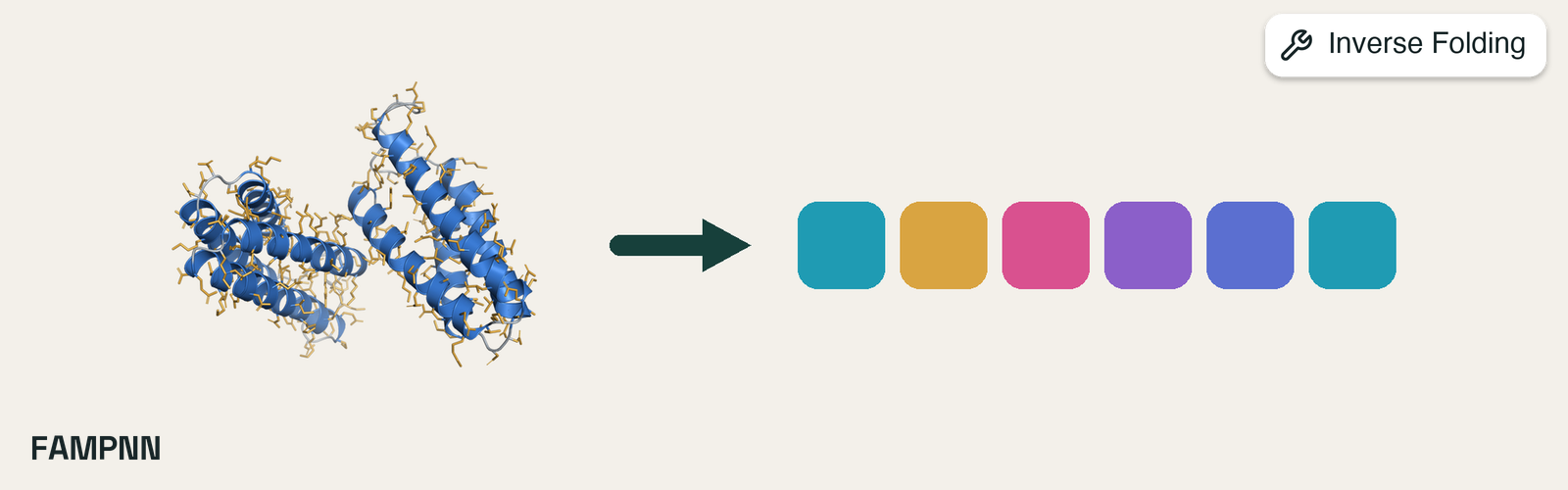
FAMPNN (Widatalla et al., 2025) solves the full-atom inverse-folding problem: given a fixed protein backbone, it predicts both an amino-acid sequence that folds into it and the sidechain conformation of every residue. Most fixed-backbone designers reason about sidechain interactions only implicitly, through backbone geometry and sequence labels, even though the three-dimensional arrangement of sidechain atoms drives protein conformation, stability, and function. Internally, FAMPNN learns a per-residue joint distribution over the discrete amino-acid identity and the continuous sidechain conformation, trained with a combined categorical cross-entropy and diffusion objective. Sequences are generated by iterative unmasking, starting from a fully masked state and revealing residues over several steps, and the sidechain atoms are produced by a per-token Euclidean diffusion process in each residue’s local backbone frame. A confidence module predicts the per-atom sidechain error (pSCE) in angstroms, which correlates with true packing error both per atom and, averaged over a residue, per residue. Learning sequence and sidechains jointly is synergistic, improving both native-sequence recovery and sidechain packing relative to modeling the sequence alone. The reference implementation is maintained at richardshuai/fampnn and was developed at Stanford University.Tools
FAMPNN Sampling (fampnn-sample)
Designs a sequence for a backbone and co-generates its full-atom sidechains. Each input structure is returned as a designed structure with packed sidechain coordinates and a per-residue pSCE.API Reference
Source
Input: FAMPNNSampleInput
Input: FAMPNNSampleInput
List[FAMPNNStructureInput]
required
Per-structure inputs, each containing a structure and optional
chains_to_redesign / fixed_positions / fixed_sidechain_positions selections. Source
Config: FAMPNNSampleConfig
Config: FAMPNNSampleConfig
string
default:"0.3"
FAMPNN checkpoint variant. ‘0.3’ for sequence design (PDB-trained, 0.3 Å noise), ‘0.0’ for sidechain packing (PDB-trained, 0.0 Å noise), ‘0.3_cath’ for mutation scoring (CATH-trained).
integer
default:"100"
Number of iterative unmasking steps for sequence design. More steps yield higher quality but slower inference. 10 steps is sufficient for high self-consistency; 100 for best quality.
boolean
default:"False"
If True, skip sidechain generation during sampling.
boolean
default:"True"
If True, repack sidechains after final sequence is determined.
number
default:"0.3"
Only condition on sidechains with predicted sidechain error below this threshold during iterative sampling.
integer
default:"50"
Number of sidechain diffusion denoising steps.
number
default:"1.5"
Step scale for sidechain diffusion (eta parameter).
integer
default:"0"
Verbosity level (0=quiet, 1=info, 2=debug, 3=raw subprocess stderr).
True is coerced to 1 and False to 0.string
default:"cuda"
Device to run the model on. Options include ‘cuda’ (NVIDIA GPU), ‘cpu’ (CPU execution), or specific GPU devices like ‘cuda:0’. Defaults to ‘cuda’.
integer
default:"3600"
Maximum execution time in seconds.
None waits indefinitely.integer
Random seed; None draws a random seed per run.
integer
default:"1"
Total number of sequences to generate per input structure.
integer
Number of sequences to process simultaneously on GPU. Defaults to num_sequences_per_structure.
number
default:"0.1"
Controls randomness in sampling from logits.
Source
Output: FAMPNNSampleOutput
Output: FAMPNNSampleOutput
List[FAMPNNDesignSet]
required
One
FAMPNNDesignSet per input structure, in input order.Applications
Use this to redesign or stabilize a protein when sidechain packing matters, for example interface or active-site redesign, since the model commits to a concrete sidechain arrangement rather than leaving it implicit. The pSCE flags residues whose packing the model is unsure about.Usage Tips
psce_threshold(default0.3) controls which generated sidechains the model conditions on. FAMPNN designs by iterative unmasking, and at each step only sidechains whose predicted error (pSCE, in angstroms) falls below this threshold are kept as context for decoding the remaining residues. Sidechains the model is less certain about (pSCE at or above the threshold) are not used as context, so low-confidence placements do not bias later predictions. Lower it to condition only on the most confident sidechains. Raise it to let more, lower-confidence sidechains inform the design.fixed_positionsandfixed_sidechain_positionsare different settings.fixed_positionsholds a residue’s amino-acid identity, whilefixed_sidechain_positionsinstead conditions on its existing sidechain coordinates. Both are per chain and indexed from 1 to match biological residue selection conventions.seq_only(defaultFalse) skips sidechain co-generation. Setting itTrueis faster but gives up the full-atom modeling that distinguishes FAMPNN, so leave it off unless you only need a sequence.- Output is structured per design.
output.design_sets[i].complexes[j]is aFAMPNNDesignwith.chains, the full-atom.structure, and.metrics["avg_psce"].FAMPNNDesignsare aComplexsubclass and can be passed directly to structure predictors.
FAMPNN Sidechain Packing (fampnn-pack)
Places sidechain atoms onto a structure whose sequence is fixed, returning the packed structure with per-atom pSCE confidence.API Reference
Source
Input: FAMPNNPackInput
Input: FAMPNNPackInput
List[FAMPNNStructureInput]
required
List of structure inputs for sidechain packing.
Source
Config: FAMPNNPackConfig
Config: FAMPNNPackConfig
string
default:"0.0"
Checkpoint variant. ‘0.0’ recommended for best packing accuracy.
integer
default:"1"
Number of packing samples per input structure.
integer
default:"16"
Number of samples to process simultaneously on GPU.
integer
default:"50"
Number of sidechain diffusion denoising steps.
number
default:"1.5"
Step scale for sidechain diffusion.
integer
default:"0"
Verbosity level (0=quiet, 1=info, 2=debug, 3=raw subprocess stderr).
True is coerced to 1 and False to 0.string
default:"cuda"
Device to run on.
integer
default:"3600"
Maximum execution time in seconds.
None waits indefinitely.integer
Random seed. When set, tools run reproducibly up to small GPU float noise (see
BaseToolOutput.approx_equal), and the seed participates in cache keys. When None, cacheable seed-sensitive tools skip cache until seeded. Source
Output: FAMPNNPackingResult
Output: FAMPNNPackingResult
List[FAMPNNPackedStructure]
required
One entry per input structure, in input order.
Applications
Use this to build or rebuild sidechains for a known sequence and backbone, for example after backbone-only design or to repair incomplete models before docking or molecular dynamics.Usage Tips
- pSCE tells you which sidechains to trust. It is the predicted per-atom sidechain error in angstroms, so high-pSCE residues are the ones to inspect or rebuild.
- Lower
batch_sizeif you run out of GPU memory. It defaults to16samples per forward pass; reduce it for large structures.
FAMPNN Mutation Scoring (fampnn-score)
Scores specified mutations on a structure with full-atom context, returning a likelihood-based score per mutation.API Reference
Source
Input: FAMPNNScoreInput
Input: FAMPNNScoreInput
List[MutationInput]
required
List of MutationInput objects, each containing a structure and mutations to score.
Source
Config: FAMPNNScoreConfig
Config: FAMPNNScoreConfig
string
default:"0.3_cath"
Checkpoint variant. ‘0.3_cath’ recommended for scoring.
integer
default:"16"
Number of mutations to score simultaneously on GPU.
boolean
default:"False"
If True, score without sidechain context (backbone-only).
integer
default:"50"
Number of sidechain diffusion denoising steps.
number
default:"1.5"
Step scale for sidechain diffusion.
integer
default:"0"
Verbosity level (0=quiet, 1=info, 2=debug, 3=raw subprocess stderr).
True is coerced to 1 and False to 0.string
default:"cuda"
Device to run on.
integer
default:"3600"
Maximum execution time in seconds.
None waits indefinitely.integer
Random seed. When set, tools run reproducibly up to small GPU float noise (see
BaseToolOutput.approx_equal), and the seed participates in cache keys. When None, cacheable seed-sensitive tools skip cache until seeded. Source
Output: FAMPNNScoreOutput
Output: FAMPNNScoreOutput
List[MutationScoreResult]
required
List of MutationScoreResult objects, one per input structure.
Applications
Use this to estimate the effect of specific point or multi-site mutations, for example triaging a designed variant list or interpreting a mutational scan, with sidechain context rather than backbone alone.Usage Tips
- Mutation strings are 1-indexed and colon-joined. Use
A1Vfor a single mutation andA1V:G5Lfor a multi-site variant. The position is counted from 1. seq_only(defaultFalse) removes sidechain context. Leaving it off scores with full-atom context, which is the point of FAMPNN; set itTrueonly for a faster, weaker backbone-style score.
FAMPNN Score All Mutations (fampnn-score-all-mutations)
Scores every possible single substitution at every position of a structure, returning a position-by-residue map of log-likelihood-ratio scores.API Reference
Source
Input: FAMPNNScoreAllMutationsInput
Input: FAMPNNScoreAllMutationsInput
List[Structure]
required
List of structures to score all mutations for.
Source
Config: FAMPNNScoreAllMutationsConfig
Config: FAMPNNScoreAllMutationsConfig
string
default:"0.3_cath"
Checkpoint variant. ‘0.3_cath’ recommended for scoring.
integer
default:"16"
Number of positions to score simultaneously on GPU.
integer
default:"0"
Verbosity level (0=quiet, 1=info, 2=debug, 3=raw subprocess stderr).
True is coerced to 1 and False to 0.string
default:"cuda"
Device to run on.
integer
default:"3600"
Maximum execution time in seconds.
None waits indefinitely.integer
Random seed. When set, tools run reproducibly up to small GPU float noise (see
BaseToolOutput.approx_equal), and the seed participates in cache keys. When None, cacheable seed-sensitive tools skip cache until seeded. Source
Output: FAMPNNScoreAllMutationsOutput
Output: FAMPNNScoreAllMutationsOutput
List[AllMutationsScoreResult]
required
List of AllMutationsScoreResult objects, one per input structure.
Applications
Use this for a full in-silico deep mutational scan, to find stabilizing or tolerated substitutions across a protein without enumerating mutations by hand.Usage Tips
- Lower
batch_sizeif you run out of GPU memory. It defaults to scoring16positions per forward pass, which dominates memory for large proteins. - Scores are log-likelihood ratios relative to the native residue. Positive values mean the substitution is favored over the wild-type residue under the model, so rank candidates by score rather than reading absolute values.
Toolkit Notes
These apply to every FAMPNN tool in this toolkit (fampnn-sample, fampnn-pack, fampnn-score, fampnn-score-all-mutations).
- Requires a GPU. The diffusion-based sidechain model is not practical on CPU.
- Each tool already defaults
model_variantto the right checkpoint.0.3for design (fampnn-sample),0.0for packing (fampnn-pack), and0.3_cathfor scoring (fampnn-score,fampnn-score-all-mutations). Each checkpoint is trained and calibrated for its own task, so reusing one across tasks degrades results.
Infrastructure Guides
The following guides cover how to run tools efficiently and at scale.Tool Persistence
Keep a tool’s model warm across calls instead of reloading it every invocation.
Device Management
How GPUs are allocated to tools and how to target specific devices.
Parallel Execution
Fan a batch of inputs out across multiple GPUs.