

This toolkit is open source. Any third-party models, product names, or trademarks referenced are the property of their respective owners, and Proto is not affiliated with them.
BackofenLab/CRISPRtracrRNA
10 stars
CRISPRtracrRNA: robust approach for CRISPR tracrRNA detection
 evo-design/proto-tools/proto_tools/tools/gene_annotation/crispr_tracr_rna
Open Notebook
Open notebook


License: CRISPRtracrRNA’s own code is licensed under MIT, and it federates over bundled data sources and components, each under its own license terms.Bundled dependencies, each under its own license:
- CRISPRcasIdentifier: GPL-3.0
Background
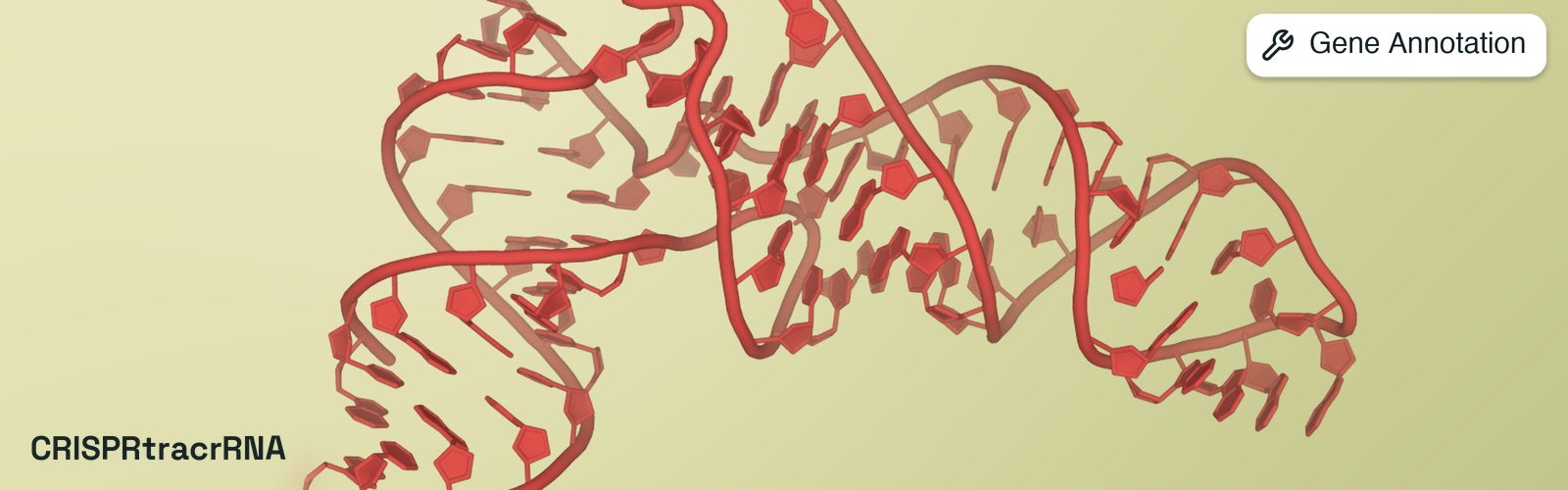
CRISPRtracrRNA (Mitrofanov et al., 2022) detects trans-activating CRISPR RNA (tracrRNA) sequences in nucleotide CRISPR loci. A tracrRNA is a small non-coding RNA that base-pairs with the precursor crRNA in the Class 2 effector systems that depend on one, namely Type II (Cas9) and the tracrRNA-bearing Type V subtypes such as Cas12b, Cas12c, and Cas12e, and the resulting RNA duplex licenses Cas-mediated cleavage of target DNA. It is also the second component fused into the single-guide RNA used in modern genome editing. Because tracrRNAs share little primary-sequence conservation across families, single-model approaches such as Infernal covariance-model search alone miss divergent tracrRNAs in newly sequenced and metagenomic genomes. Internally, the pipeline runs an array-detection step with CRISPRidentify (machine learning), a Cas-cassette step with CRISPRcasIdentifier (HMM and machine learning), a tracrRNA candidate scan with Infernalcmsearch against curated covariance models, an anti-repeat alignment step using fasta36, vmatch, Clustal Omega, and BLAST, an RNA-RNA interaction step with IntaRNA, and a transcription-terminator step with erpin. A final ranking step combines the per-candidate features into a single weighted score, and a faster model_run mode performs only the covariance-model scan and skips the validation evidence and the ranking step.
Learning Resources
- BackofenLab/CRISPRtracrRNA (Bioinformatics Group Freiburg) - official repository with installation instructions, the canonical configuration surface, and the curated covariance models distributed with the tool.
- EddyRivasLab/infernal (The Eddy/Rivas Laboratory, Harvard) - official repository and User’s Guide for the covariance-model search engine and the
cmsearchE-value statistics that score tracrRNA candidates. - BackofenLab/IntaRNA (Bioinformatics Group Freiburg) - official repository for the RNA-RNA interaction predictor that scores the anti-repeat to repeat duplex.
Tools
CRISPRtracrRNA Prediction (crispr-tracr-rna)
Predicts tracrRNA candidates from one or more nucleotide sequences and returns, per input sequence, a list of CrisprTracrRNAPrediction rows sorted by ranking score. Each row carries the candidate position and sequence, CRISPR array context, anti-repeat similarity and coverage, predicted RNA-RNA interaction with the repeat, terminator location and score, distance to the nearest Cas-effector cassette, and a single weighted multi-evidence score.API Reference
Source
Input: CrisprTracrRNAInput
Input: CrisprTracrRNAInput
List[string]
required
Nucleotide sequence(s) to predict tracrRNA from. Each sequence should contain a CRISPR locus. Labeled positionally (
seq_0, seq_1, …); results are returned in input order. Source
Config: CrisprTracrRNAConfig
Config: CrisprTracrRNAConfig
enum
default:"II"
CRISPR model type.Available options:
II, allenum
default:"complete_run"
Pipeline mode.Available options:
complete_run, model_runinteger
Parallel workers across input sequences (defaults to 1).
number
default:"0.7"
Minimum anti-repeat ↔ repeat similarity (0-1).
number
default:"0.6"
Minimum anti-repeat alignment coverage (0-1).
number
default:"0.5"
Ranking weight for CRISPR array confidence.
number
default:"0.5"
Ranking weight for anti-repeat similarity.
number
default:"0.5"
Ranking weight for anti-repeat coverage.
number
default:"0.5"
Ranking weight for similarity x coverage.
number
default:"0.6"
Ranking weight for IntaRNA interaction energy.
number
default:"0.9"
Ranking weight for the covariance-model tail hit.
number
default:"0.9"
Ranking weight for erpin terminator score.
number
default:"0.1"
Ranking weight for orientation consistency.
number
default:"0.1"
Ranking weight for anti-repeat ↔ tail consistency.
number
default:"0.1"
Ranking weight for tail ↔ terminator consistency.
boolean
default:"False"
Type V (Cas12) anti-repeat search.
integer
default:"0"
Verbosity level (0=quiet, 1=info, 2=debug, 3=raw subprocess stderr).
True is coerced to 1 and False to 0.string
default:"cpu"
Device to run the tool on.
integer
default:"3600"
Maximum execution time in seconds.
None waits indefinitely.integer
Random seed. When set, tools run reproducibly up to small GPU float noise (see
BaseToolOutput.approx_equal), and the seed participates in cache keys. When None, cacheable seed-sensitive tools skip cache until seeded. Source
Output: CrisprTracrRNAOutput
Output: CrisprTracrRNAOutput
List[CrisprTracrRNASequenceResult]
One result per input sequence, each carrying all candidate hits upstream produced for that sequence (top-ranked first).
Applications
Use this to confirm and characterize Type II and Type V CRISPR-Cas loci, since a detected tracrRNA is the component that completes a functional Class 2 locus and distinguishes a Cas9 or Cas12 system from an unaccompanied CRISPR array. Pair it withminced on a confirmed array to recover the crRNA spacers, then design a single-guide RNA by fusing a spacer-bearing crRNA with the detected tracrRNA scaffold for genome-editing experiments. Run it across metagenomes and uncultured genomes to discover novel Cas9 or Cas12 systems whose tracrRNAs are too divergent to be caught by covariance-model search alone.Usage Tips
- Provide each CRISPR locus with at least 5 kb of flanking sequence on either side. The multi-evidence pipeline needs adjacent context to locate the Cas cassette and the downstream transcription terminator. Loci submitted as narrow windows lose those evidence channels and fall back to a covariance-model-only score.
model_typedefaults to"II", which only screens for Cas9 systems. To also screen tracr-bearing Type V (Cas12b, Cas12c, Cas12e, …) loci, setmodel_type="all"andperform_type_v_anti_repeat_analysis=True. The Type V path is off by default because it is slower and irrelevant when only Cas9 loci are of interest.- Type I and Type III CRISPR systems do not use a tracrRNA. A
complete_runon such a locus returns array context and Cas annotations but empty tracrRNA fields, with the ranking score reflecting only the partial evidence. - The ten
weight_*ranking parameters interact. Sweep them together against a held-out positive and negative set rather than tuning a single weight in isolation, and keep upstream’s documented defaults when there is no specific objective to optimize for. run_type="model_run"is the high-throughput pre-filter, not the final answer. It runs only the Infernalcmsearchstep and returns candidates with E-values but none of the array, interaction, or terminator evidence, so re-run promising candidates throughcomplete_runbefore drawing conclusions.
Toolkit Notes
These apply to every CRISPRtracrRNA tool in this toolkit (crispr-tracr-rna).
- Runs on CPU only. The pipeline drives Infernal, IntaRNA, fasta36, vmatch, Clustal Omega, BLAST, and erpin, all CPU-based programs. There is no GPU acceleration to enable.
- Initial install pulls model archives from Google Drive.
complete_runmode requires the CRISPRcasIdentifier ML and HMM archives, which the standalone install fetches once. Google Drive rate-limits anonymous fetches, so on a failed install retry after a minute or follow the upstream README to place the two archives in the CRISPRcasIdentifier directory by hand. After install the runtime needs no further network access. num_workersparallelizes across input sequences, not within a sequence. Each worker runs the full pipeline in its own working directory to avoid file-name collisions between concurrent jobs. The default of 1 is single-process; set it explicitly when batch-scanning many loci. The wrapper caps the effective worker count atlen(sequences), so over-provisioning is safe.
Infrastructure Guides
The following guides cover how to run tools efficiently and at scale.Tool Persistence
Keep a tool’s model warm across calls instead of reloading it every invocation.
Device Management
How GPUs are allocated to tools and how to target specific devices.
Parallel Execution
Fan a batch of inputs out across multiple GPUs.