

 Proto
ProtoLicense: Random Protein Sampling is open source and free for academic and commercial use under an MIT license. Please refer to the license for full terms.
Proto is not affiliated with Proto. This toolkit is open source and builds on the implementation produced by this organization. Product names, logos, and trademarks are the property of their respective owners.
 evo-design/proto-tools/proto_tools/tools/mutagenesis/random_protein
Open Notebook
Open notebook


Background
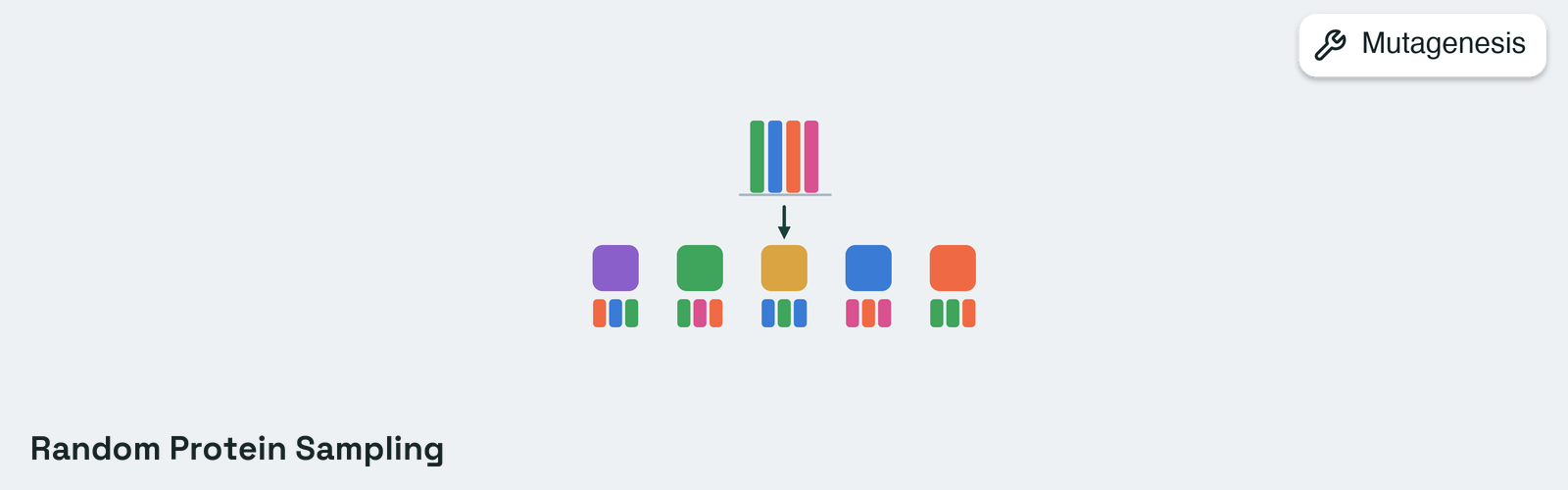
Random Protein Sampling performs random mutagenesis at the protein level: it takes a protein sequence, determines which positions are designable, and replaces each with an amino acid sampled from the distribution implied by a codon scheme. It generates protein-sequence diversity without any learned model, the simplest possible baseline against which model-guided designers can be compared. Internally, designable positions are either the_ characters already present in the input or, when none are present, positions chosen by the configured masking strategy. The codon scheme is expanded to its concrete codons, and each amino acid’s sampling weight is set proportional to the number of codons in the scheme that encode it, with stop codons excluded by default. UNIFORM instead assigns equal weight to all twenty standard amino acids. If excluded_amino_acids is set, those residue types are removed after codon-scheme and stop-codon handling; the sampler raises an error if no reachable residue remains. Each masked position is filled independently by a weighted random draw. With a fixed seed the output is deterministic.
This tool is original proto-tools code maintained by Proto.
Tools
Random Protein Sampling (random-protein-sample)
Fills every masked position in each input sequence with a random amino acid drawn from the configured codon scheme, returning one filled sequence per input.API Reference
Source
Input: MaskedModelSampleInput
Input: MaskedModelSampleInput
List[string]
required
Protein sequence(s) with
_ at the positions the model should fill in. A sequence carrying no _ is masked by the configured masking strategy instead. Source
Config: RandomProteinSampleConfig
Config: RandomProteinSampleConfig
RandomMaskingStrategy
Controls which positions to mask for sampling.
enum
default:"UNIFORM"
Codon scheme controlling amino acid sampling probabilities.
"UNIFORM" gives equal weight to all 20 amino acids; other schemes (NNK, NNS, NDT, etc.) weight amino acids by the number of codons encoding them.Available options: UNIFORM, NNN, NNK, NNS, NDT, DBK, NRTboolean
default:"False"
If True, the stop symbol
"*" is included in the sampling distribution. For degenerate schemes it is weighted by its stop-codon count; for "UNIFORM" it is an equally weighted 21st symbol. Default: False (stops never sampled).array
One-letter codes of amino acids to remove from the sampling distribution after codon-scheme and stop-codon handling. An empty list is treated as
None.integer
default:"0"
Verbosity level (0=quiet, 1=info, 2=debug, 3=raw subprocess stderr).
True is coerced to 1 and False to 0.string
default:"cpu"
Device to run the tool on.
integer
default:"3600"
Maximum execution time in seconds.
None waits indefinitely.integer
Random seed. When set, tools run reproducibly up to small GPU float noise (see
BaseToolOutput.approx_equal), and the seed participates in cache keys. When None, cacheable seed-sensitive tools skip cache until seeded. Source
Output: RandomProteinSampleOutput
Output: RandomProteinSampleOutput
List[RandomProteinSample]
required
One sampled sequence per input, in input order.
Applications
Use this to build randomized protein libraries that mimic experimental degenerate-codon mutagenesis, for exampleNNK saturation at chosen positions for directed-evolution and combinatorial screening. It also serves as an unbiased random baseline for judging whether a model-guided designer beats chance.Usage Tips
codon_scheme(defaultUNIFORM) sets the amino-acid distribution.UNIFORMdraws all twenty amino acids equally; degenerate schemes (NNK,NNS,NDT,DBK,NRT) weight each amino acid by how many of the scheme’s codons encode it, so residues such as leucine, serine, and arginine appear more often than methionine or tryptophan.NDTgives an even 12-amino-acid library. It encodes twelve amino acids with no codon redundancy, so each is equally likely; useful for small focused libraries.- Stop codons are excluded by default. Set
allow_stop_codonstoTrueto include the stop symbol*in the distribution: for degenerate schemes it is weighted by its stop-codon count, and forUNIFORMit is an equally weighted 21st symbol. excluded_amino_acidsremoves residues from sampling. For example, set["C"]to avoid cysteine or["C", "A"]to remove cysteine and alanine from every masked position. An empty list is treated likeNone; excluding every residue reachable by the selectedcodon_schemeraises an error._masks override the masking strategy. If an input already contains_, exactly those positions are filled andmasking_strategyis ignored; remove the_characters to let the strategy choose positions instead.masking_strategy.fixed_positionsare 1-indexed. Positions listed there are never mutated; they are specified using 1-based indexing to match biological residue selection conventions.- Set
seedfor reproducibility. Sampling is otherwise nondeterministic; a fixed seed makes the filled sequences reproducible across runs.
Toolkit Notes
These apply to every Random Protein Sampling tool in this toolkit (random-protein-sample).
- Runs on CPU. The sampler is pure Python with no model and no external dependencies; execution is near-instant.
- Deterministic only with a seed. Without a
seedthe filled positions differ every run; set one when you need reproducible libraries.
Infrastructure Guides
The following guides cover how to run tools efficiently and at scale.Tool Persistence
Keep a tool’s model warm across calls instead of reloading it every invocation.
Device Management
How GPUs are allocated to tools and how to target specific devices.
Parallel Execution
Fan a batch of inputs out across multiple GPUs.